FREE PACK · 12 MATERIALS + EVERY PROMPT
The material pack.
A filter grades a photo. These remake it out of a different substance: cast bronze, machined aluminium, moulded plastic, woven cane, burnt-down wax, matted wool, grown fungus. Same pose, same frame, completely different matter.
Before you run them.
- Use image edit. You're remaking a photo you already have. Nano Banana Pro (Gemini 3 Pro Image), on higgsfield.ai or fal.ai. Upload, paste, run.
- Never delete the last line. Every prompt ends by locking pose, framing and composition. That line is the whole trick. It keeps your picture and changes only what it's made of. Cut it and you get a different photo.
- Name the process. Don't ask for something that looks like bronze. Say it was cast in wax, burned out and poured. The mechanism is what the model can actually build from, and it's why these come back as objects instead of textures.
- If it comes back timid, push it. Looks like your photo with a colour cast? The model played safe. Add "abandon the original rendering entirely" and run it again. Four of these twelve needed exactly that.
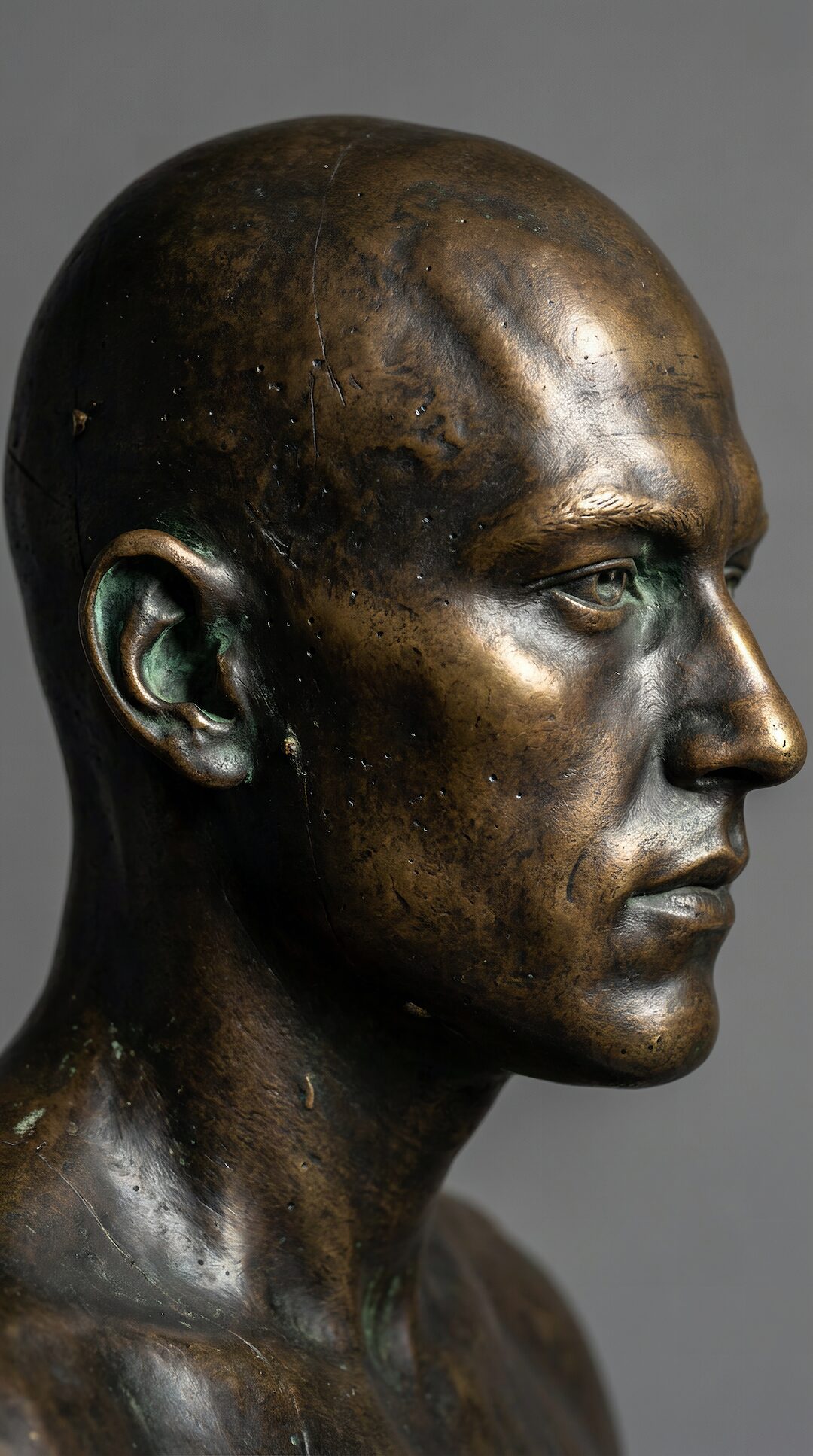
Cast Bronze.
Cast metal is soft where carved stone is sharp. Say the object was modelled in wax first and the model stops trying to chisel it.
Image edit · Nano Banana Pro.
Cast Bronze
Transform the subject of this photograph into a lost-wax cast bronze sculpture. The figure is no longer flesh or fabric: it is a hollow shell of poured bronze that took the shape of a wax original, burned out of its mould and filled with molten metal. Every surface carries the foundry on it: faint parting lines where the mould halves met, small ground-flat stubs where the sprues and risers were cut away, scattered porosity pinholes, and the slightly swollen softness of a form that was modelled in wax rather than carved from stone. The patina is decades old: deep brown-black settled into the recesses, green verdigris blooming in the sheltered hollows, and warm gold-brown polished through on the high points where hands have touched it for years. Hard directional light so the modelling reads through the dark metal. The environment stays real and photographic around it, so the bronze reads as a physical object standing inside a real photograph. Keep the subject, pose, framing and composition exactly as they are.
Machined Billet.
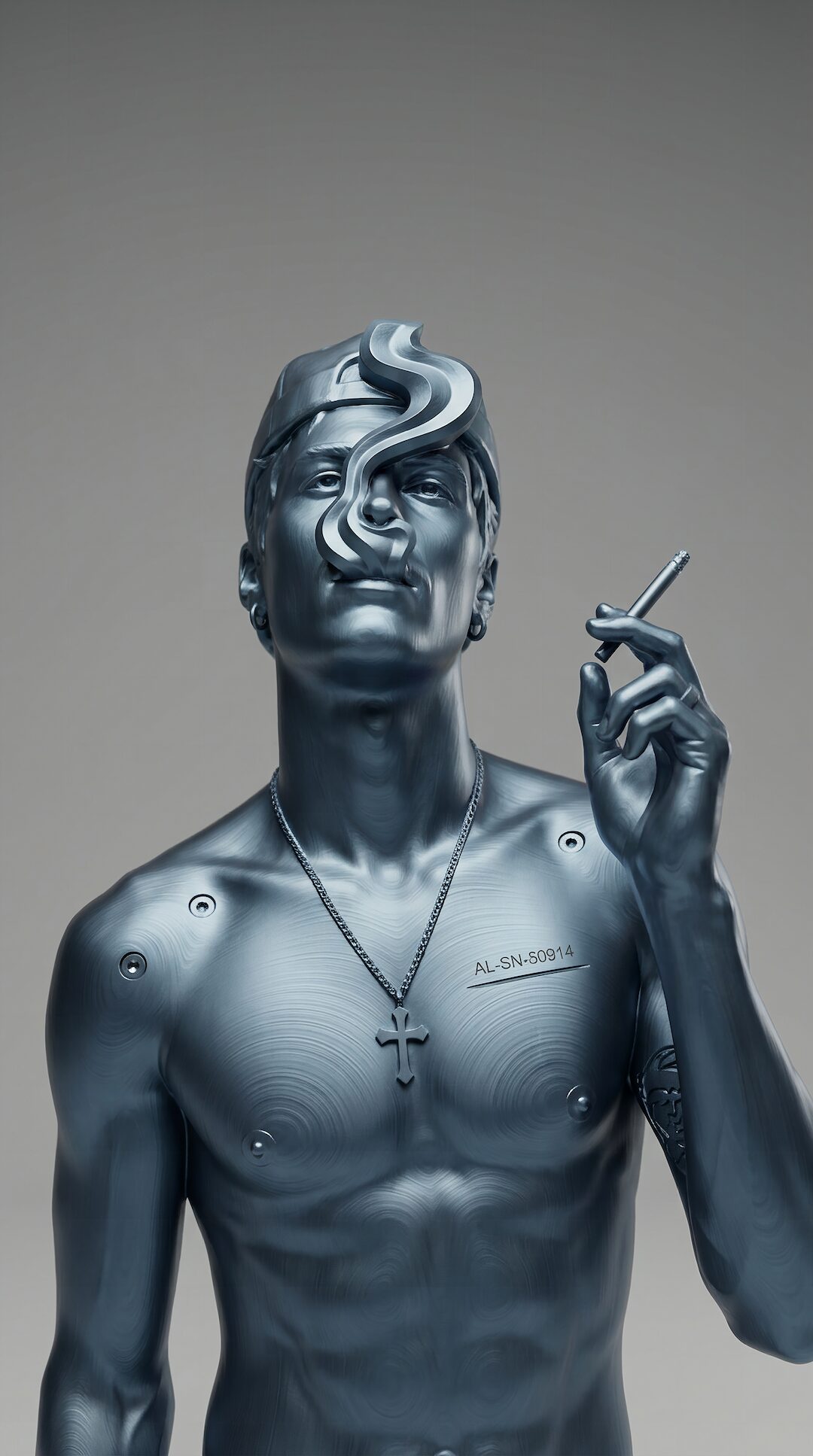
A machined part can only have shapes a cutter can physically reach. Name the tool and you stop getting detail no tool could ever produce.
Image edit · Nano Banana Pro.
Machined Billet
Transform the subject of this photograph into an object CNC-machined from a solid billet of aluminium. Abandon the original rendering entirely: there is no skin, no cloth and no clay left anywhere in the frame, only bare metal with a cool blue-grey specular sheen and a fine directional machining grain running across every face. Nothing here was moulded or grown: every surface was cut away by a spinning endmill, so concentric tool paths ripple across the broad faces in fine parallel arcs, every edge is chamfered or filleted to one consistent radius, and the form is simplified into the machinable version of itself with no undercut a cutter could never reach. Soft details become hard geometry: countersunk fasteners, precision-tapped holes, a laser-etched serial number and a shallow engraved index line. The whole part is bead-blasted to an even matte and hard-anodised in a single flat colour, so light reads as a broad soft sheen rather than a mirror, with the anodising going slightly deeper and darker in the internal corners. A witness mark shows where it was held in the vice. Cold neutral studio light, plain seamless ground, shallow depth of field. Keep the subject, pose, framing and composition exactly as they are.
Injection-Moulded Plastic.
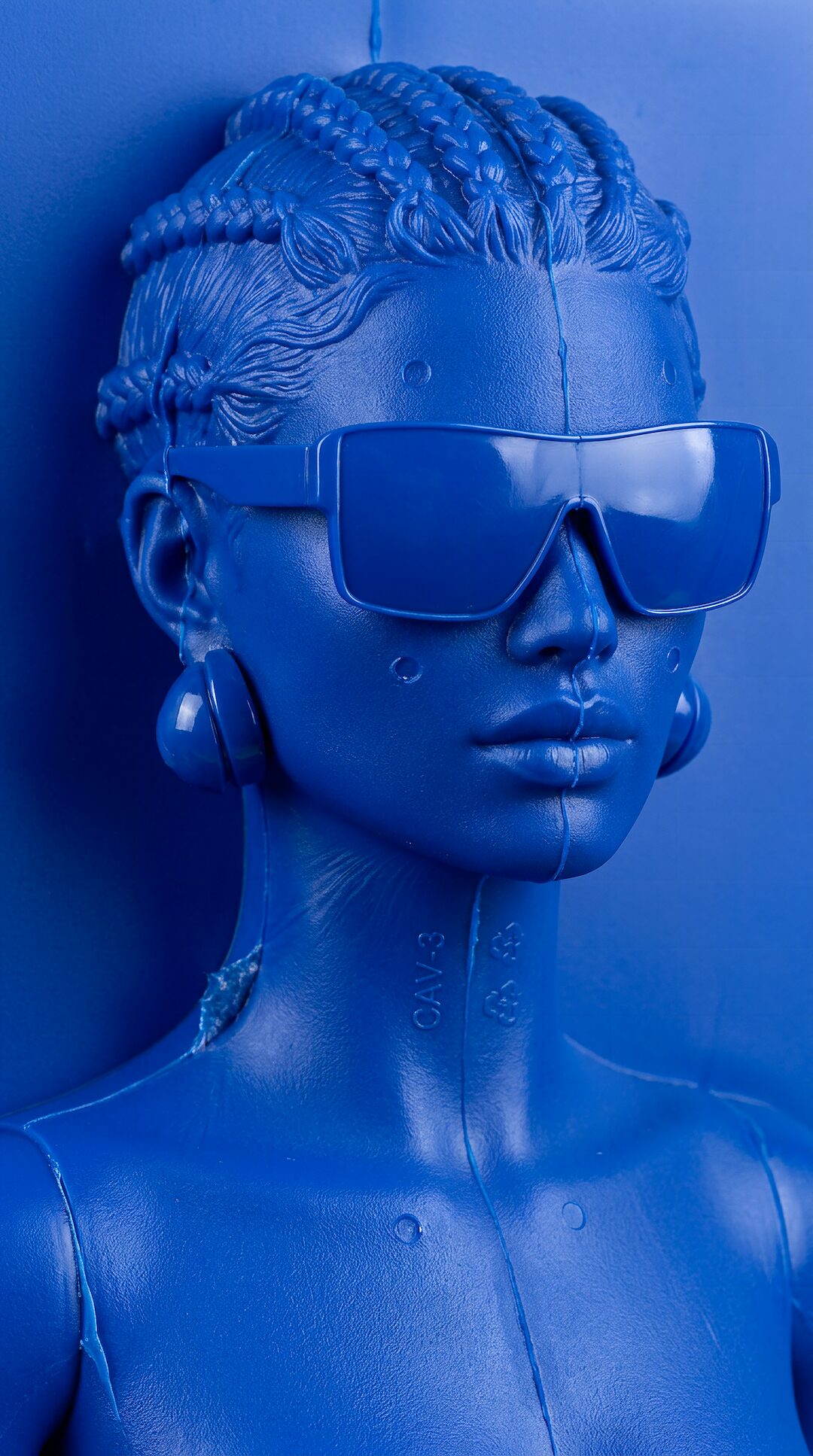
A moulded part can only have shapes that pull cleanly out of a steel tool. Ask for the parting line and the ejector marks and the whole object starts obeying that rule.
Image edit · Nano Banana Pro.
Injection-Moulded Plastic
Transform the subject of this photograph into an injection-moulded plastic figure. Abandon the original rendering entirely: no skin, no hair and no fabric survive anywhere, only rigid polymer that was shot molten into a steel tool under pressure and left to cool. The object carries its manufacture openly: a fine parting line runs right around the form where the two halves of the mould closed, small circular ejector pin marks are sunk into the flatter faces, a cut sprue scar sits low on one side, and a thin flash of squeezed-out plastic survives along part of one seam. The surface is really the tool's surface, lightly grained where the steel was textured and glossy where it was polished, with faint flow lines fanning out from the gate and shallow sink marks wherever the wall runs thick behind. Detail is simplified to whatever a mould can release, so undercuts are gone and every form draws cleanly away. The plastic is one saturated colour straight through, with a cavity number and a small recycling symbol moulded into a back face. Keep the subject, pose, framing and composition exactly as they are.
Woven Rattan.
A woven thing is full of holes, so light goes through it. Say the background shows through the gaps and it stops being a texture painted onto something solid.
Image edit · Nano Banana Pro.
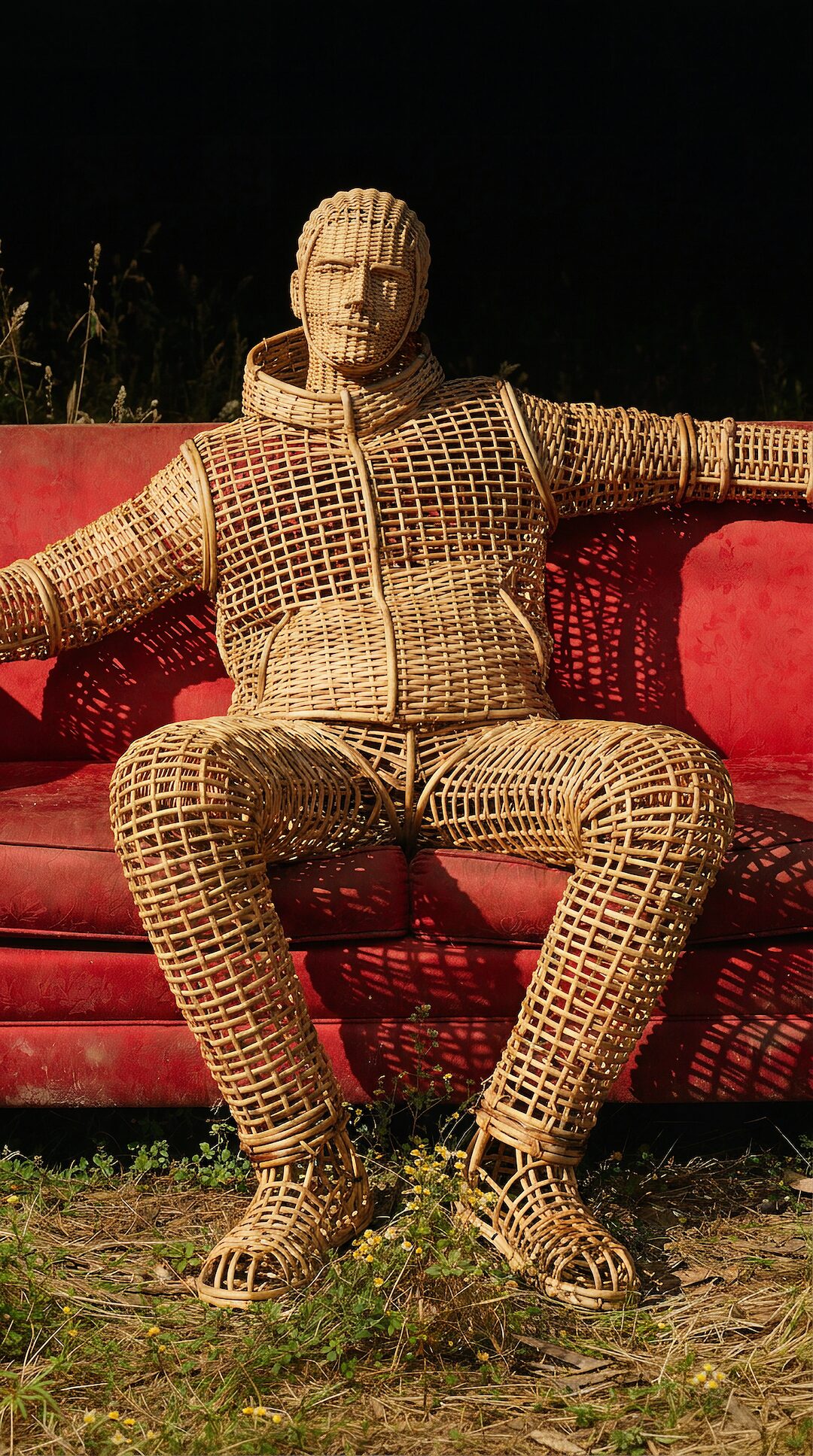
Woven Rattan
Transform the subject of this photograph into a hand-woven rattan form. It was built the way basketwork is built: lengths of thick cane steamed and bent into a structural frame, then finer split cane woven over and under across it in a continuous warp and weft that follows the surface of the shape and changes direction wherever the form turns. Because it is woven it is not solid, and that is the whole point: light passes through the gaps between the canes, the background shows faintly through the thinner areas, and the form throws a broken lattice shadow rather than a filled one. The cane is real and used: pale honey where it is fresh, darkened amber where hands have worn it, faintly scorched at the tight bends where it was heated to make the turn, with cut ends bound in tight wrapped binding and a few splinters and frayed strands lifting away from the weave. Fine detail cannot survive a weave this coarse, so small features are simplified into broad woven volumes. Warm daylight. Keep the subject, pose, framing and composition exactly as they are.
Carved Limewood.
Wood has a direction and stone does not. Once you name the grain, the splits and the tool facets all have to agree with it.
Image edit · Nano Banana Pro.
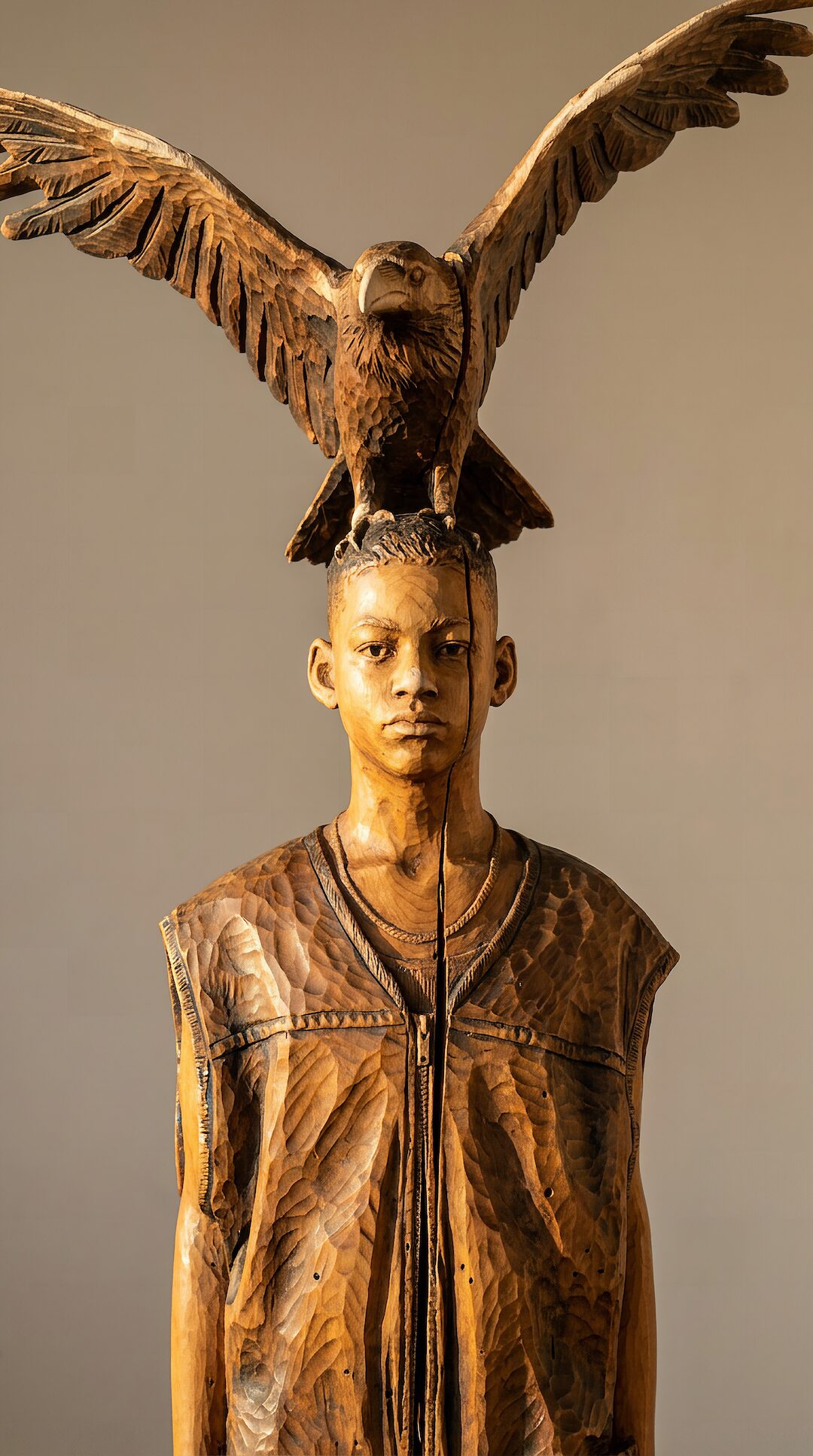
Carved Limewood
Transform the subject of this photograph into a limewood carving in the Riemenschneider tradition. It was cut from a single seasoned block, so one long drying split runs up through the form following the grain, and growth rings surface wherever the carver cut across them. Nothing is sanded smooth: the entire surface is made of gouge facets, each cut catching light as its own small plane, with fine chisel chatter left in the tight areas the tool could barely enter. Detail is simplified into the language of the gouge, drapery reduced to deep confident scoops and ridges. The wood is warm honey brown, darkened almost black with old wax and candle soot in the recesses, rubbed back to pale bare timber on the high points. Old worm holes run through it, and the original polychrome survives only as flecks of blue and gold trapped in the deepest cuts. Warm side light. Keep the subject, pose, framing and composition exactly as they are.
Folded Origami.
One sheet, no cuts, no glue. That single constraint is what forces the model to simplify instead of decorate.
Image edit · Nano Banana Pro.
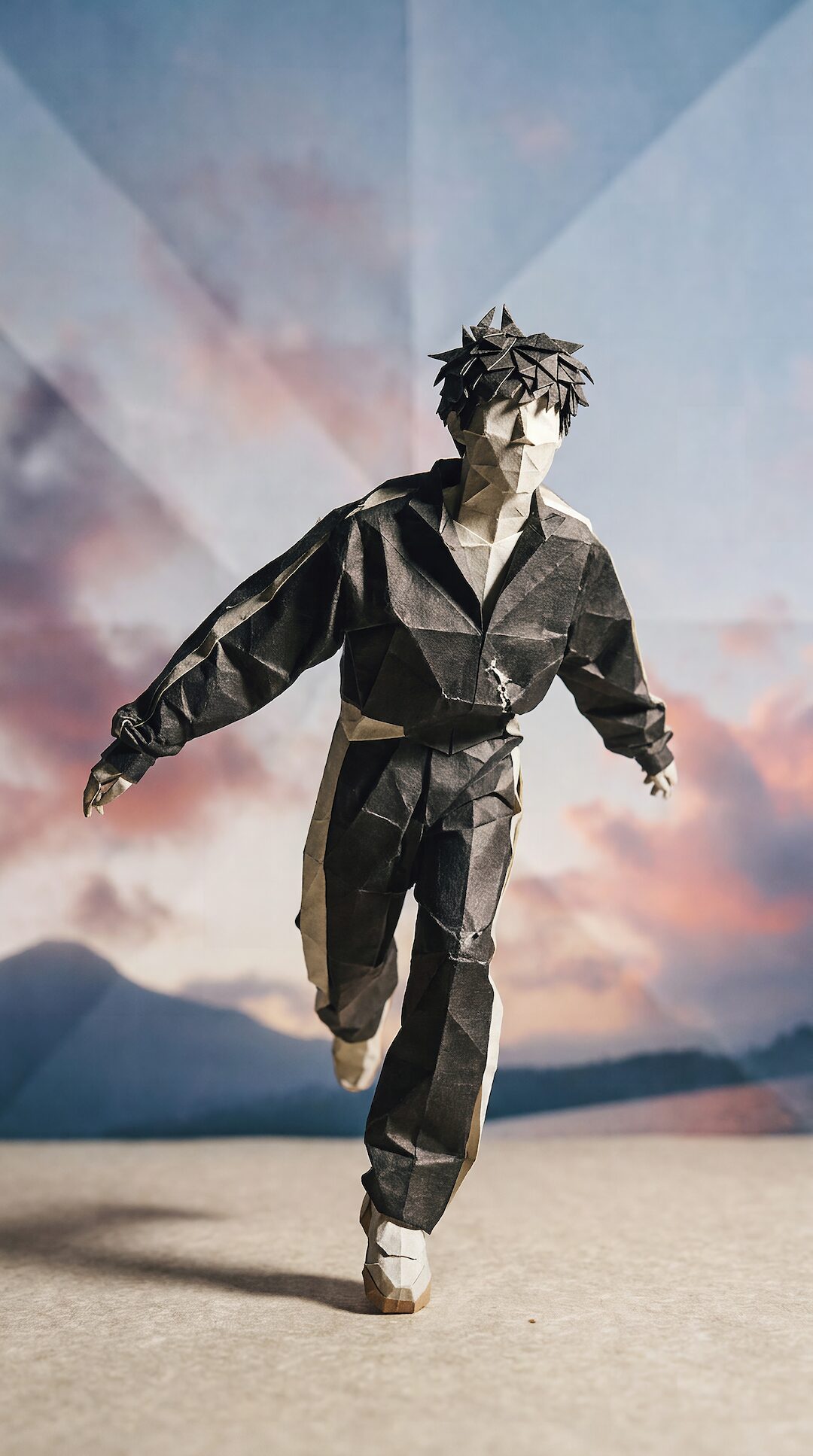
Folded Origami
Transform the subject of this photograph into a figure folded from a single uncut sheet of paper. Nothing is curved, cut or glued: every form is a flat facet meeting its neighbours along a crisp crease, so round shapes become faceted approximations and fine detail collapses into a handful of decisive planes. Mountain folds catch light along their ridges while valley folds hold hard shadow. Layers of paper stack visibly thicker at the joints, and the raw edges of the original square appear somewhere on the finished form. The paper is real: heavy textured kami with visible fibre, a different colour on its reverse that shows wherever a flap turns over, faint ghost creases from folds that were made and reversed, and a small stress tear at one over-worked corner. It sits on a plain surface throwing a soft shadow, photographed close with shallow depth of field. Keep the subject, pose, framing and composition exactly as they are.
Etched Circuit Board.
A copper trace turns at ninety or forty-five degrees, never freehand. Give the model the routing rule and you stop getting wires that merely look like wires.
Image edit · Nano Banana Pro.
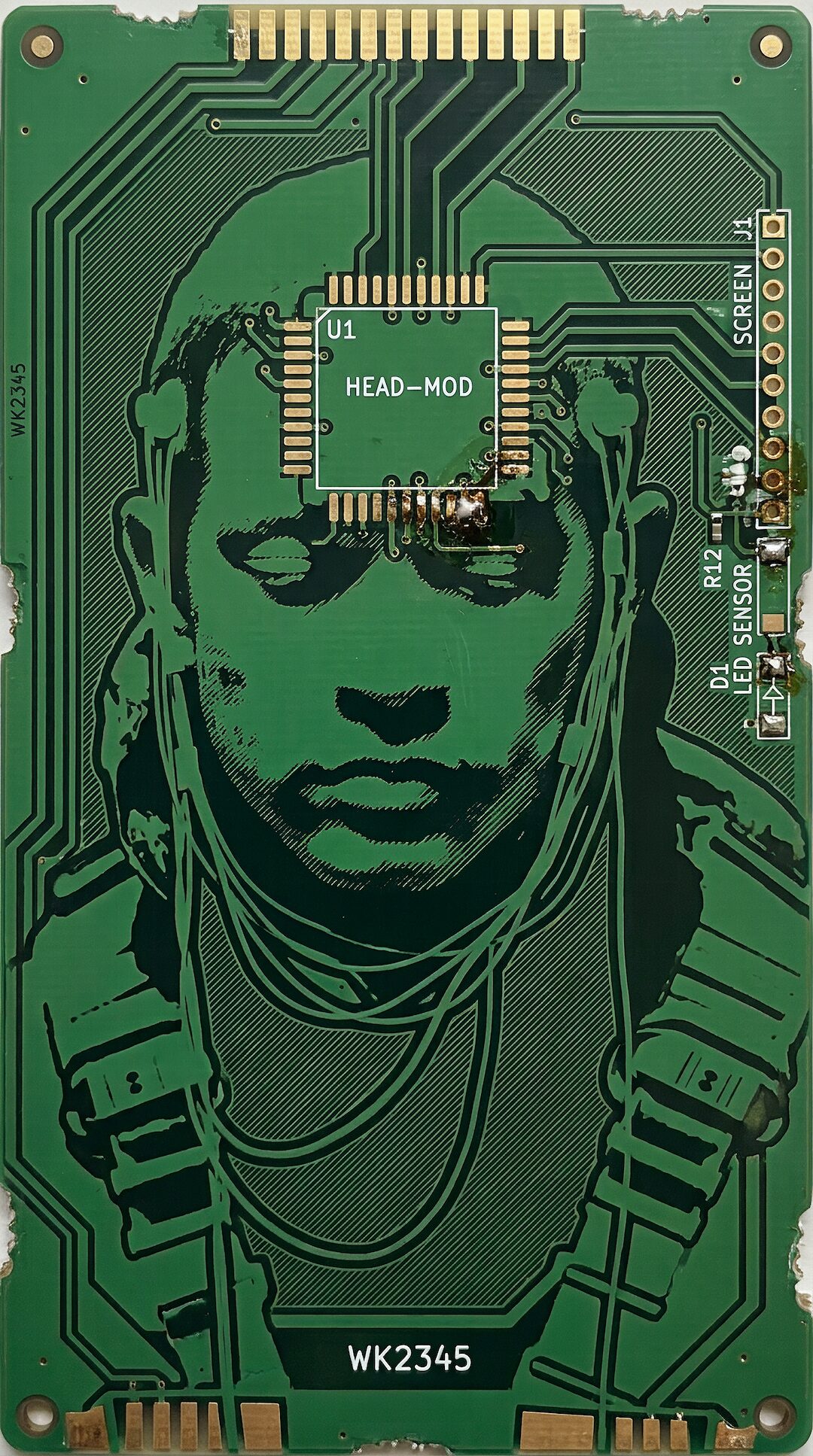
Etched Circuit Board
Transform this photograph into an etched printed circuit board. The whole image is re-described as two-layer copper routing on green FR-4: thick power traces and fine signal traces running only in straight segments and forty-five degree turns, never a free curve, with vias stitching between layers wherever a route has to cross. Broad tonal areas become copper pour filled with a fine hatch grid. The board is properly finished: matte solder mask laid over the copper so the traces read as slightly raised darker channels beneath it, white silkscreen legend printed on top carrying component outlines and reference designators in a tiny technical sans, and bare gold-plated pads and edge fingers where the mask is cut away. Real production marks are present: a date code, a fiducial in each corner, milled board edges with visible mouse bites left from the panel, and a few hand-soldered joints with brown flux residue never cleaned off. Lit flat and close, like a product shot. Keep the subject's shape, framing and composition exactly as they are.
Votive Beeswax.
Wax lets light travel about an inch inside before it stops, and that is the whole difference between wax and plastic. Say how deep the light gets.
Image edit · Nano Banana Pro.
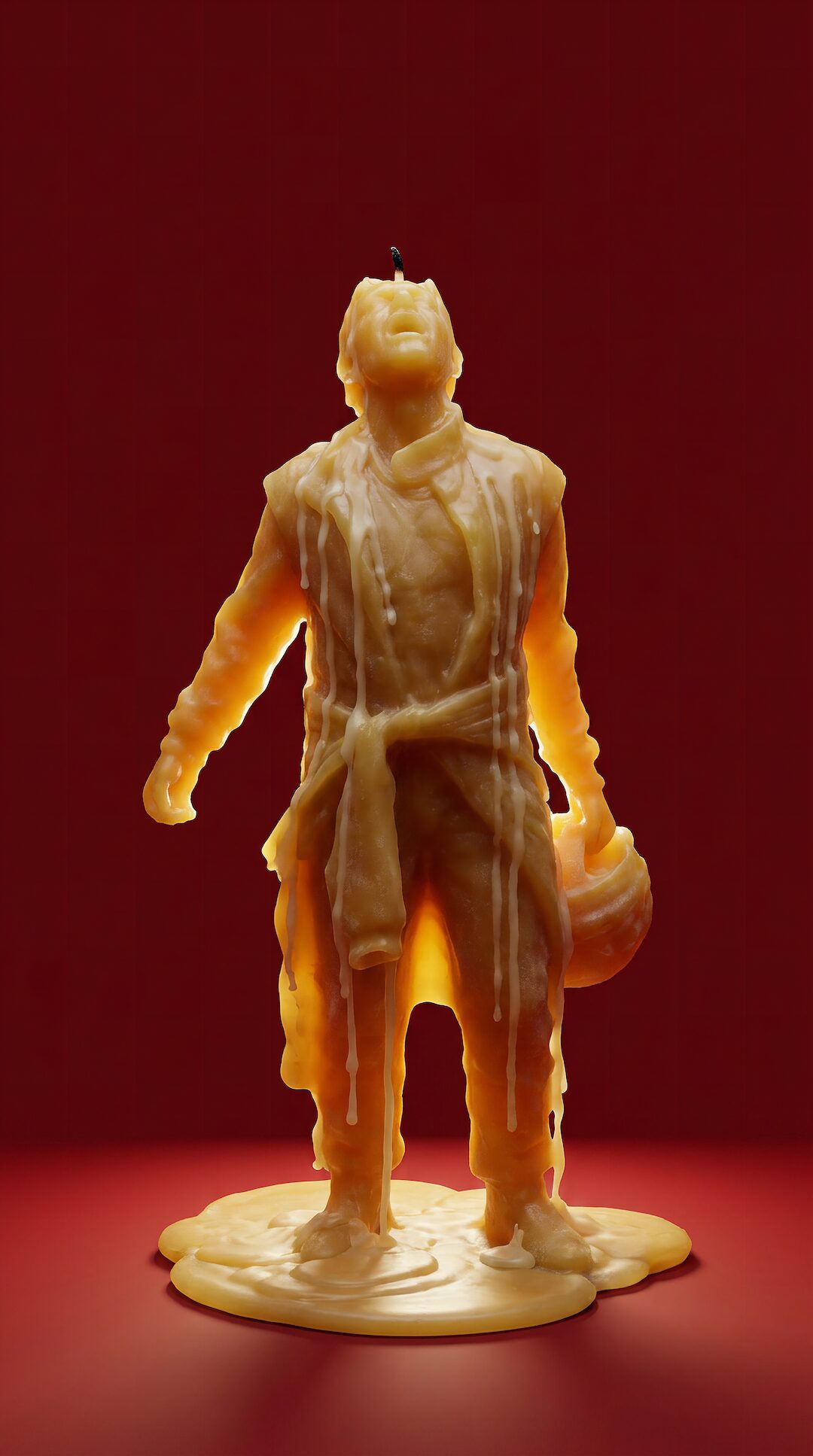
Votive Beeswax
Transform the subject of this photograph into a votive candle cast in beeswax and left burning for hours. It was poured into a mould so it holds the shape faithfully, and the whole figure stays clearly readable: the stance, the limbs and the silhouette all survive, and only the surface has been softened. Heat has taken only that surface: features have softened and rounded into each other, and long runs have poured down the sides and set into pale ridged tears that spread into a pooled disc at the base. The head is fully intact and still reads clearly as a head, with the face softened but entirely present, and nothing above the shoulders has melted away or been lost. A single blackened wick rises from a small shallow melt pool at the very crown, above the face, and the melting goes no deeper than that. The wax is dense translucent honey-yellow, glowing warmly where it is thin because light travels an inch into it before it stops, and going opaque and creamy where it is thick, with a faint dusty bloom on the surfaces that have sat untouched. Fingerprints and the original mould seam survive on the cooler lower parts. Replace the surroundings entirely with a flat field of deep oxblood red, fully saturated, no horizon and no detail in it at all, so the candle stands as a single object against solid colour. Light it warm and slightly from the front so the honey wax glows hot against the red and throws a soft pool of light across the ground it sits on. Keep the subject, pose, framing and composition exactly as they are.
Needle-Felted Wool.
Felt has no hard edges because the fibres migrate as you stab them. Ask for softness at the colour boundaries as well as a woolly texture.
Image edit · Nano Banana Pro.
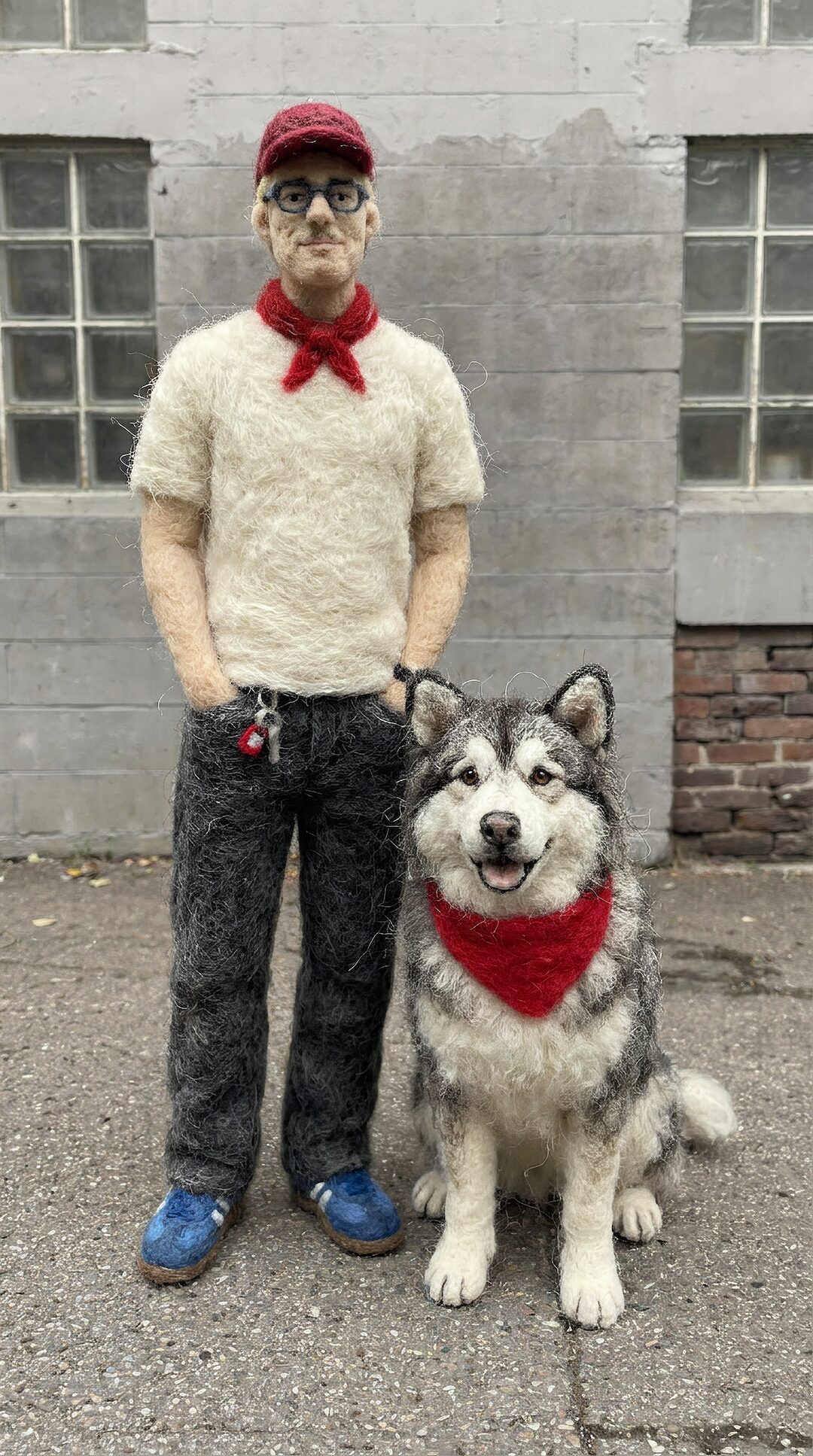
Needle-Felted Wool
Transform the subject of this photograph into a needle-felted wool sculpture. Abandon the original rendering entirely: this is an object made of wool, not a photograph of anything real. There is no skin, no woven cloth and no actual fur anywhere in it, only matted fleece standing in for all of them. It was built by stabbing loose carded fleece thousands of times with a barbed needle until the fibres tangled and locked, so nothing is smooth or precise: every form is a soft, slightly lumpy mass wearing a faint fuzzy halo of stray fibres that glows wherever it catches the light. The making shows: needle pocks dimple the denser areas, and the surface is compacted hard where it was worked most and left woolly and open where it was not. Colour is limited to dyed fleece laid on in patches and blended only by carding, so every boundary between colours is soft and slightly migrated, never a clean edge. Details are reduced to what the technique can hold: small features become tiny felted nubs, fine lines become thin strands of wool laid on and pressed down. Soft diffused daylight, plain background. Keep the subject, pose, framing and composition exactly as they are.
Tooled Leather.
Leather has no lines, only cuts and the shadows they throw. Once tone can only come from depth, the whole image has to be redrawn in relief.
Image edit · Nano Banana Pro.
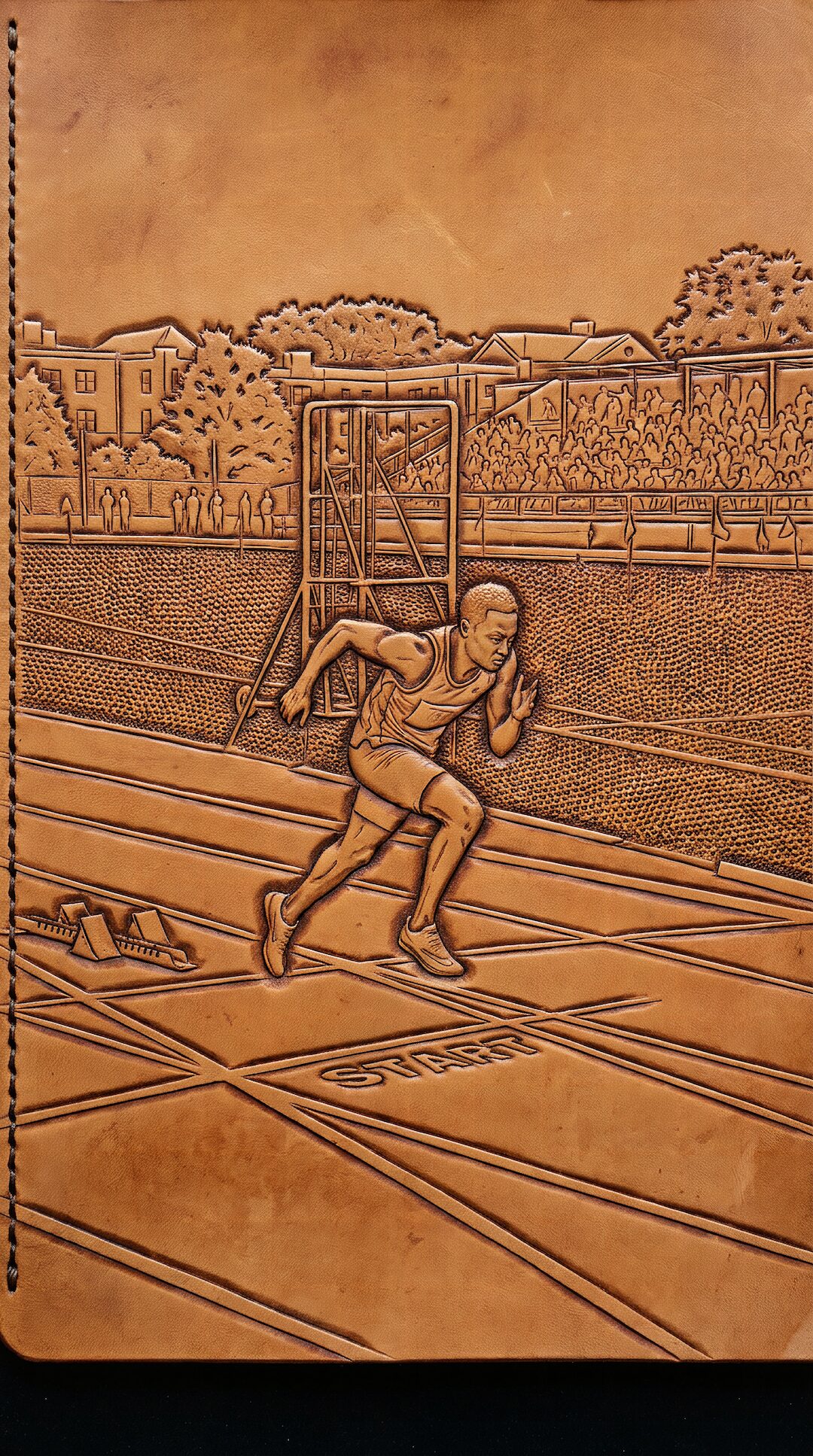
Tooled Leather
Transform this photograph into a panel of hand-tooled vegetable-tanned leather. The image was cased damp and cut into the hide with a swivel knife, so every outline is a fine incised valley rather than a drawn line, then beveled down one side of each cut so the shapes lift into shallow relief with a soft shaded edge. Background areas are stamped down with a matting tool into a dense field of small repeated impressions, pushing the main forms forward. Tone comes only from depth and dye: the panel is antiqued so dark oil-brown pigment has settled into every cut and every stamped hollow, while the raised surfaces stay warm tan, buffed slightly glossy from burnishing. The hide is genuinely used: natural range marks and open pores in the grain, darkened patina where it has been handled most, edges beveled and burnished to a hard round, and a line of heavy waxed saddle stitch running down one side. Keep the subject's shape, framing and composition exactly as they are.
Grown Mycelium.
Grown things swell, cast things shrink, carved things cut. Naming which one you want decides every edge in the picture.
Image edit · Nano Banana Pro.
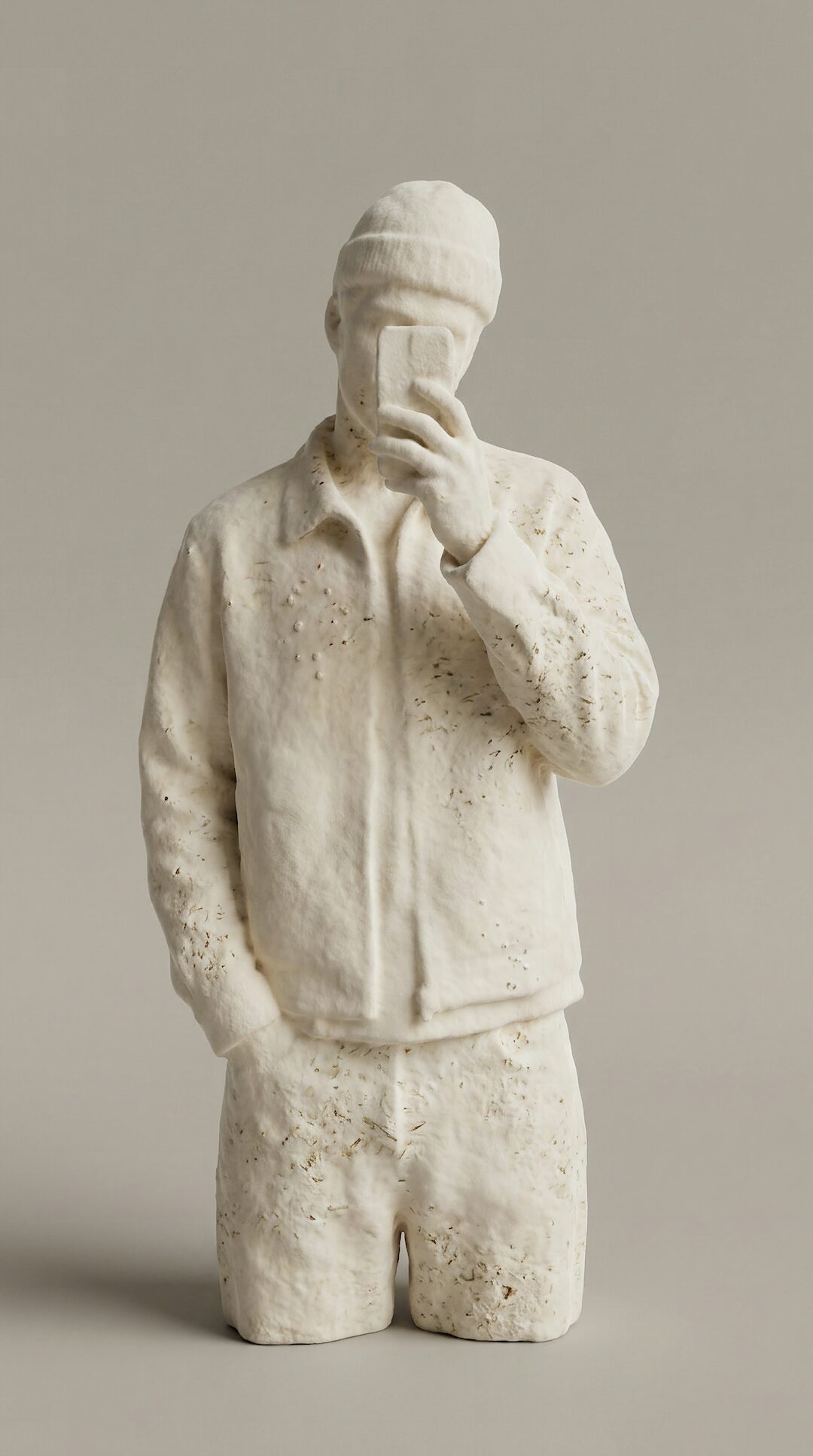
Grown Mycelium
Transform the subject of this photograph into an object grown from mycelium. It was neither cast nor carved: a mould was packed with loose hemp substrate, inoculated, and the fungus was left in the dark to thread through it until the entire volume knitted solid, then heat-killed to stop it. The result is a dense pale cream-white monolith with the soft matte skin of a fungal mat, faintly velvety, the shape slightly swollen and organic wherever growth pushed against the mould wall. Its origin shows through: chopped hemp fibre and substrate flecks suspended just under the surface, skin that is smooth and tight where it met the mould and rougher and more open where it grew free, small pinning bumps, and hairline shrinkage cracks where it dried unevenly. Detail is soft and generalised everywhere, as though the form were breathed rather than cut. Neutral daylight, plain ground. Keep the subject, pose, framing and composition exactly as they are.
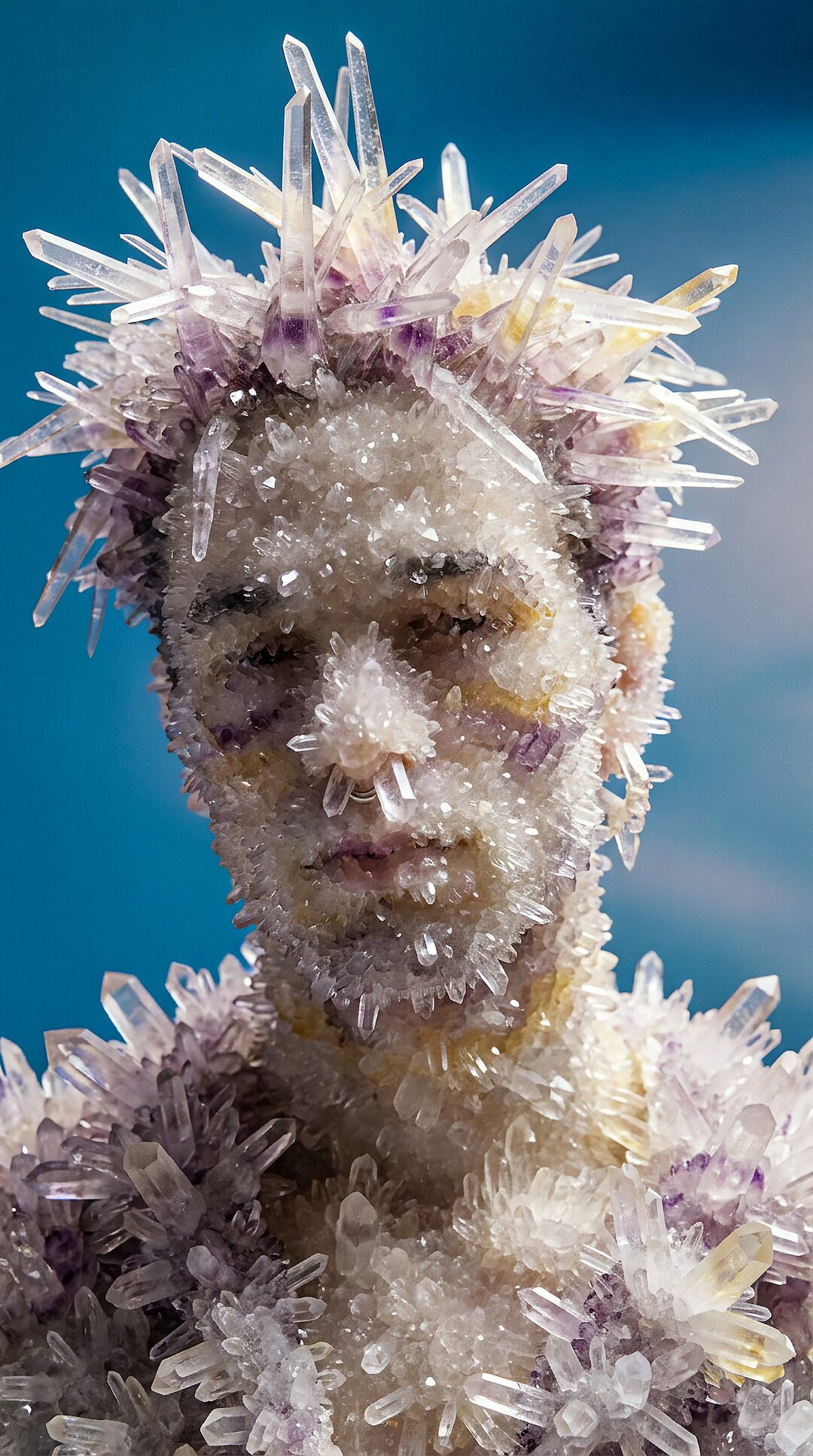
Crystal Growth.
Crystals grow outward from edges and points, unevenly. Tell the model where growth had room and the silhouette does the work.
Image edit · Nano Banana Pro.
Crystal Growth
Transform the subject of this photograph into a form encrusted in grown mineral crystals. The original object was suspended in a supersaturated solution and left alone, so crystals nucleated on it and grew outward: a dense fine druzy sugar across the broad flat surfaces, and long well-formed prismatic crystals reaching out from every corner, edge and point where growth had room to run. No original surface survives uncovered anywhere: skin, hair and clothing all disappear beneath the crystal, so the whole thing reads as a mineral specimen rather than a person wearing crystals. The growth follows the underlying shape but thickens and blurs it, so the silhouette turns furred and spiky and fine detail vanishes completely beneath it. Each crystal is a real solid with flat faces and a sharp termination, semi-transparent so light enters, bounces around inside the cluster and lights it from within, throwing pale colour into the shadows. The growth changes as it goes: clear at the tips, cloudy white in the crowded base, with faint amethyst and citrine banding where the solution shifted. Hard raking light so the terminations flare. Keep the subject's shape, framing and composition exactly as they are.
The point.
Anyone can run a preset. Knowing that a mould can't hold an undercut, that wax passes light an inch deep, that a weave lets the background through, that grown things swell where cast things shrink: that's the part you can't download. Taste beats tech. Always has.
Take it with you.
BUILD AI CREATIVE SYSTEMS · 2027 EDITION
Start your one-person studio.
Make the campaigns, ads and films brands pay agencies thousands for. On your own, from your bedroom, with AI doing a team’s job. Then get paid for it.
800+ creatives trained37 countries225K+ follow along
The full 2027 Edition
$797$597
Founding rate until 9 Dec
Get the courseOne payment. Instant access. The 2027 Edition is yours for life.
- Make an advert film
- Shoot a product campaign
- Build a fashion campaign
- Make a music video
- Cast like a director
- Build your AI studio
Everything inside
- The full course. Brief to paid job, in the order I use it on real work.
- 6 mini courses inside. Advert film, product campaign, fashion campaign, music video, casting, your AI studio.
- Hotline: 90+ ready-made skills. The course running inside your own Claude or ChatGPT.
- The locked prompts and skills from freebies like this one. New freebies land in the course first, in full.
- Get paid. What to sell, what to charge, and the proposal that wins the job.
- Lessons in 15 languages. Captions and text in yours.
- Quarterly updates for 12 months. What changed in the tools, tested first.
- One payment. The 2027 Edition is yours for life.
On this freebie
Free here
- All 12 material prompts
- The four rules for running them
Course members
- 90+ ready-made skills in Hotline